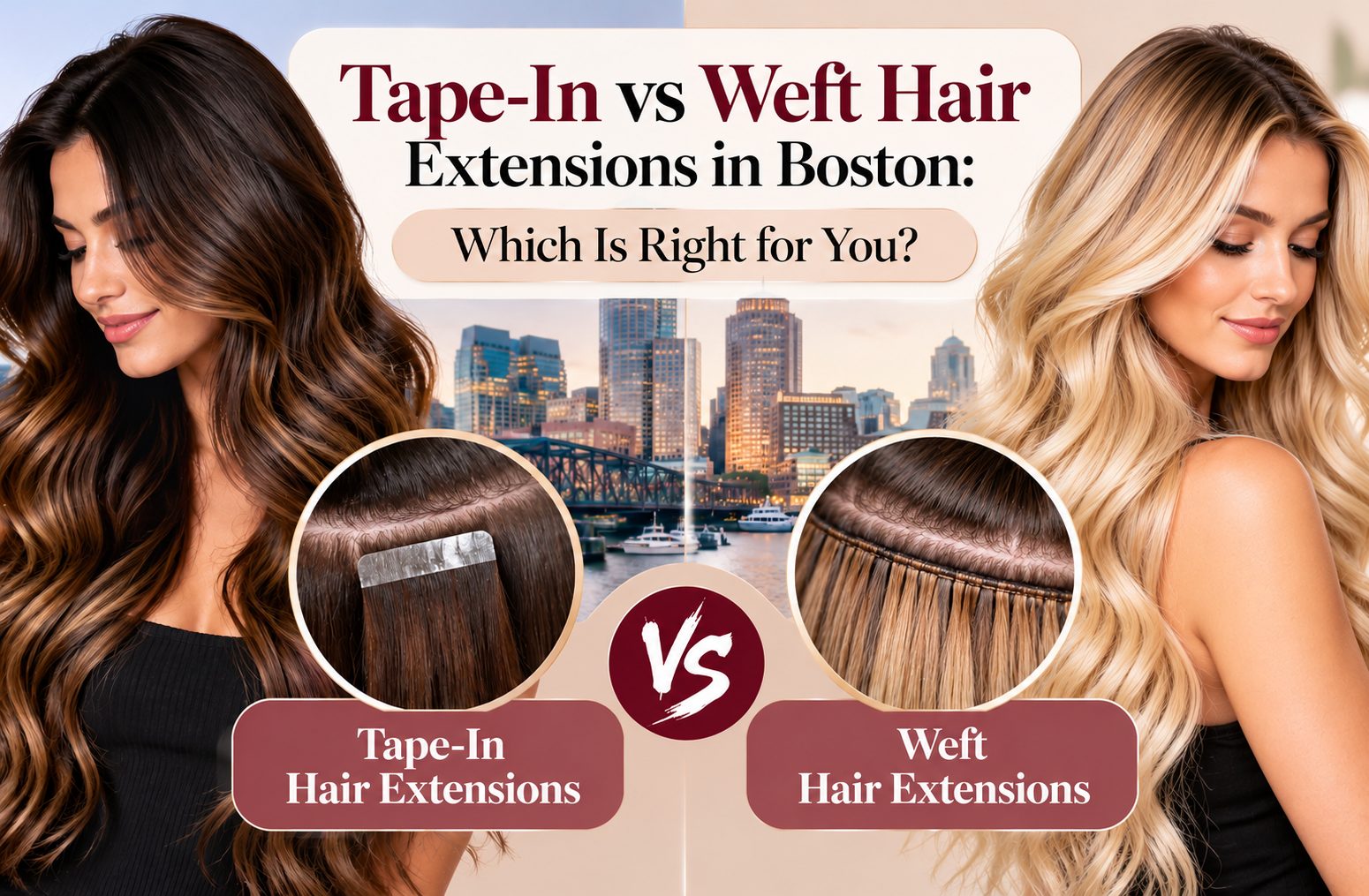
If you’re thinking about extensions in Boston, the choice usually comes down to tape-ins or wefts. Both can look completely natural. The difference is in how they attach, how much hair you can add, how they feel and how much upkeep they need.
In short: tape-ins suit fine to medium hair and a lighter look. Weft hair extensions suit medium to thick hair and anyone who wants more volume and length.
New to extensions? Start with our beginner’s guide to hair extensions in Boston.
What are tape-in extensions?
Tape-ins are thin panels of hair, about an inch or two wide, with medical-grade adhesive along the top. Your stylist places a small section of your natural hair between two panels so they lie flat against your head.
People like them because they’re lightweight, sit very flat and go in fairly quickly. If you’re comparing tape-in extensions in Boston, they’re often the first option for fine hair.
What are weft hair extensions?
A weft is a long strip of hair joined at the top. Instead of many small panels, your stylist attaches one or more longer rows across the back of your head. Here’s more on why weft hair extensions are popular for fuller, longer hair.
Common types include:
- Hand-tied wefts: very thin and flexible, for a seamless look close to the head.
- Machine wefts: a bit thicker and sturdier. Many can be cut to any width.
- Sewn-in wefts: stitched onto a small braid or a row of beads. This is a traditional method that’s great for thicker or textured hair.
Most modern weft methods use small beads or a thin braid, with no glue or heat.
Tape-in vs weft: side-by-side
| Tape-ins | Weft hair extensions | |
| How they attach | Adhesive panels around your hair | Rows sewn or beaded onto your hair |
| Best for | Fine to medium hair | Medium to thick hair, big volume goals |
| Feel | Very flat and light | Smooth, with a little structure along the row |
| Volume | Light to moderate | Moderate to dramatic |
| Install time | Usually shorter | Usually longer |
| Glue or heat? | Adhesive | Usually none |
| Product limits | Keep oils and conditioner off the tape | Fewer limits; keep the row clean and dry |
Comparing more methods? See hair extensions in Boston: which type is right for you.
How Boston weather affects your extensions
Boston’s weather is tough on hair, and extensions feel it too.
- Humid summers: frizz and tangling increase, and tape adhesive can loosen with heat and sweat. Braid your hair loosely for sleep and the beach, and rinse after swimming in salt water or chlorine.
- Dry, cold winters: indoor heating and wind dry out extension hair, which can’t make its own oils. A hydrating mask (kept away from tapes and bonds) and gentle heat styling help.
- Hats and scarves: wool rubs against the back of your head, so smooth your hair underneath and detangle gently afterwards.
Our hair extension maintenance guide covers daily care in more detail.
How long do tape-ins and wefts last?
There are two answers: the time between appointments and the life of the hair itself.
As a general guide, both methods need a move-up every six to eight weeks or so as your natural hair grows. Good-quality hair can often be reused for several move-ups with good care. Your stylist will check the hair at each visit.
Machine weft vs hand-tied: which is better?
Neither one is better overall.
- Hand-tied gives the flattest, most invisible row, and suits fine to medium hair.
- Machine weft is more durable and flexible in width, and suits thicker hair.
Some clients get a mix, such as a machine weft at the back with narrower pieces near the sides.
Which is gentler on your natural hair?
Damage usually comes from too much weight, a too-tight install or skipped move-ups, not from the method itself.
- Tape-ins spread the weight over many small sections, which suits fine hair. They need a proper solvent to remove them, never pulling.
- Wefts put more hair on each row, so your natural hair needs enough density to support it.
We cover this in detail in are hair extensions damaging?
What affects the cost of extensions in Boston?
Prices vary by salon, hair quality and how much hair you need, so be careful with any single number you see online. The main factors are:
- The number of tapes or rows
- Hair quality and length
- The method, since hand-tied usually takes more time
- Color matching and blending
- Ongoing move-ups
Ask for an estimate that covers the install and maintenance. For a full breakdown, read how much hair extensions cost in Boston.
Questions to ask a hair extension salon in Boston
- Is my hair thick enough for wefts?
- How many rows or tapes will I need?
- How often are move-ups, and what do they cost?
- How long will the hair last with my routine?
- Which products should I use, and avoid?
Our guide on how to choose a hair salon in Boston has more tips.
So, which should you choose?
Choose tape-ins if:
- Your hair is fine to medium
- You want subtle length or volume
- You prefer a shorter appointment
Choose weft hair extensions if:
- Your hair is medium to thick, or textured
- You want noticeable volume and length
- You’d rather avoid adhesive
FAQ
Can you feel weft extensions?
You might notice the row for the first few days. Most people stop noticing it after that.
Can I wear my hair up with wefts?
Yes, in many styles. Your stylist can place the rows so loose ponytails and buns still hide them.
Are tape-ins or wefts better for fine hair?
Tape-ins or hand-tied wefts are usually the gentlest choice for fine hair.
Will Boston humidity ruin my extensions?
No, but it means a bit more care. Braid your hair for sleep, rinse after swimming and dry the attachment area fully.
Can I color my extensions?
Leave it to a professional. Extension hair can react differently to color, so ask our hair coloring and highlights team.
Get weft or tape-in extensions on Newbury Street
The right method is the one that fits your hair and your life. At Enlighten Beauty Studio, our hair salon on Newbury Street, we’ll look at your hair, talk through your goals and recommend tape-ins, wefts or a mix. Planning a wedding? See bridal hair and makeup.
Explore our hair extension services in Boston, or call (781) 866-4772 to book a consultation. We’re at Suite 206, 207 Newbury St, Boston.